
Every tool that touches your model bill says it saves you money.
But when your finance team or your board asks you to prove it, a spend chart can't. It shows what you paid, not what you would have paid. So the saving is a matter of faith, and it falls apart at the first hard question.
Operant gives every call a record with three numbers. A call on a model with no known price shows a dash instead. Potential is what the same work would have cost without Operant. Actual is what it really cost. Saved is the difference, credited to the change that earned it.
Potential isn't a guess
Potential is the same call, priced again with Operant's changes undone in three stated ways. The same text is priced at the model that would have served it without Operant. That's usually the model your agent asked for. Any text that Operant removed is put back. And the cache that Operant set up is taken out.
Each line of the record says which change earned it:
- A cache line says how much text was read from the cache instead of sent again at full price. It only counts the cache reads that Operant's own marks caused. A cache write shows as a negative amount: its extra cost, which later reads can pay back.
- A compression line says how many old tool results were hidden, and how much less text went out.
- A model-switch line names the rule that used a cheaper model. It prices the turn at the model that would have served it without Operant.
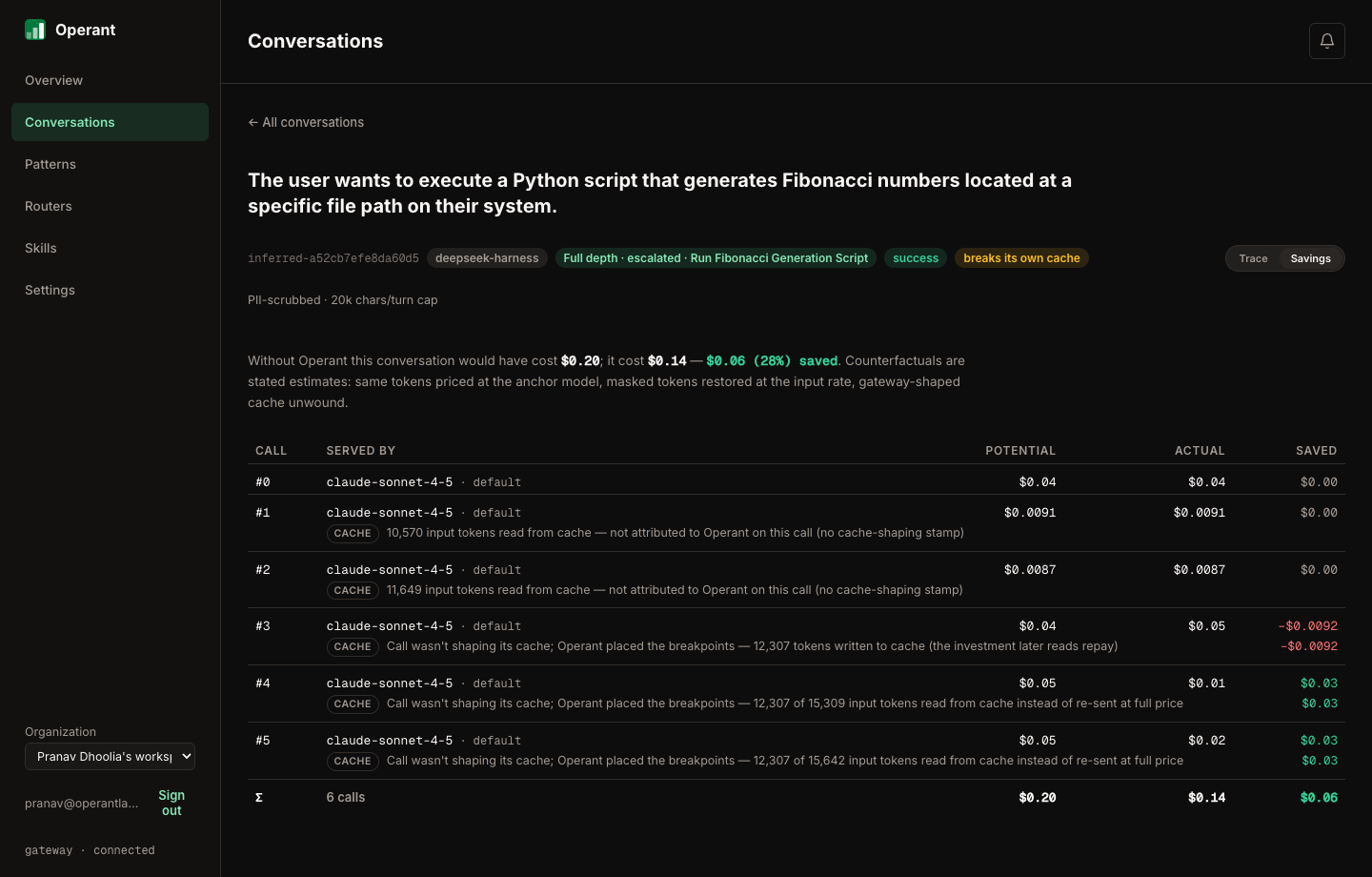
The assumptions are part of the record
Each conversation's savings view states its assumptions, including the model behind the price and how the cache is taken out. A number with hidden assumptions can't be defended. A number with explicit ones can be worked out again by someone who doesn't trust us. That's the whole point.
What the record isn't
It isn't a dashboard you have to take on faith. It's per call, per change, with the rules for undoing each change in the open. You can argue with the arithmetic.
It also isn't a scoreboard that only goes up. If a change saves nothing on your workload, the record shows nothing. Its credibility comes from being willing to report a boring number.
How pricing works
Paid plans combine a modest base fee with a share of the savings the record verifies. The share is capped, so you always keep the large majority. If you don't like variable pricing, you can take a flat fee set at the recent share instead.
The usual fight with savings-based pricing is over what you would have paid. The record exists to settle that fight. Its assumptions go in the contract, and an independent party can work them out again.
So every saving lands as a line you can check: per call, per change, with its assumptions written down. A change that saves nothing shows nothing.
When someone asks you to prove a saving, you can hand them arithmetic they can redo themselves.
See how plans are priced on the pricing page.