
Every production agent pays for the same structure. It resends the whole conversation each turn, redoes repeated work on a top model and carries old tool output along.
You pay for all of that on every call. It isn't a bug in your code, but the shape of how agents talk to providers.
Today we're opening Operant. It sits between your agents and the model provider. It finds that waste, prices it and removes it, one tested and reversible step at a time.
Change two lines
You install Operant by changing two lines: the base URL and your Operant key. Your instructions, tools and code stay the same. It speaks the Anthropic and OpenAI APIs, so anything that already talks to a model can talk to Operant. Your agents can keep their own model keys, or store one in Operant. Streaming still works, and every turn is priced to the cent.
It watches before it acts
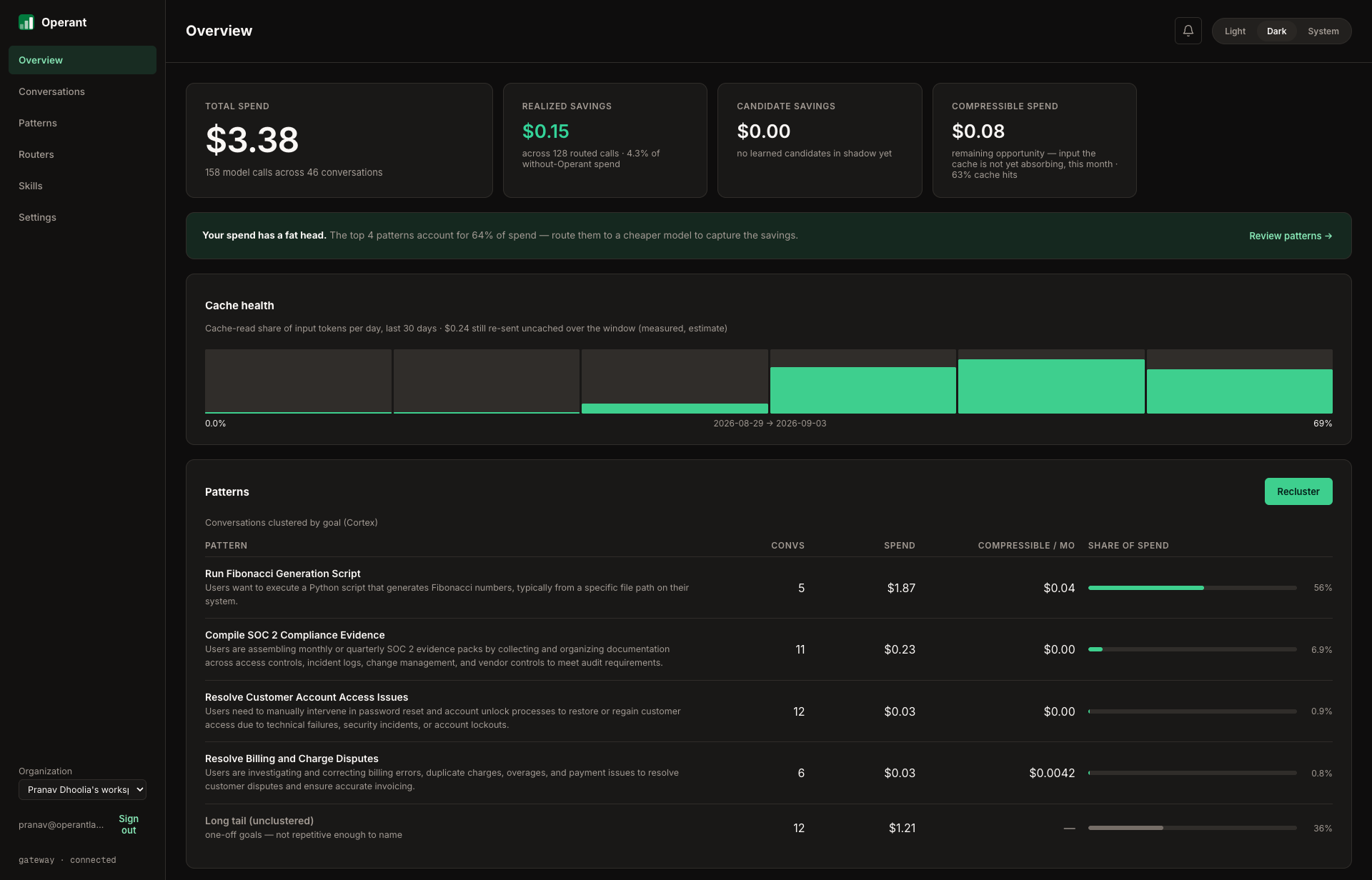
At first it only watches. It groups calls into conversations, from chat threads to coding-agent sessions with their sub-agents. Each one gets its goal named and its spend tied to the key that sent it.
Then it fixes one thing at a time
Only then do the fixes come in. Cache shaping turns the part of the conversation that grew last turn into a cheap cache read this turn. Compression hides the old tool results that a long session drags along. And model switching moves repeated work to cheaper models that carry the skill they need. A skill is short instructions learned from your own past chats that didn't fail.
Every fix is opt-in. Model switching and compression follow the same path. They run without touching live traffic and pass a test on chats they never saw. They only go live when you approve. Cache marks don't change what the model reads, so they need no test. One click turns a model switch or compression off again.
Every saving comes with its arithmetic
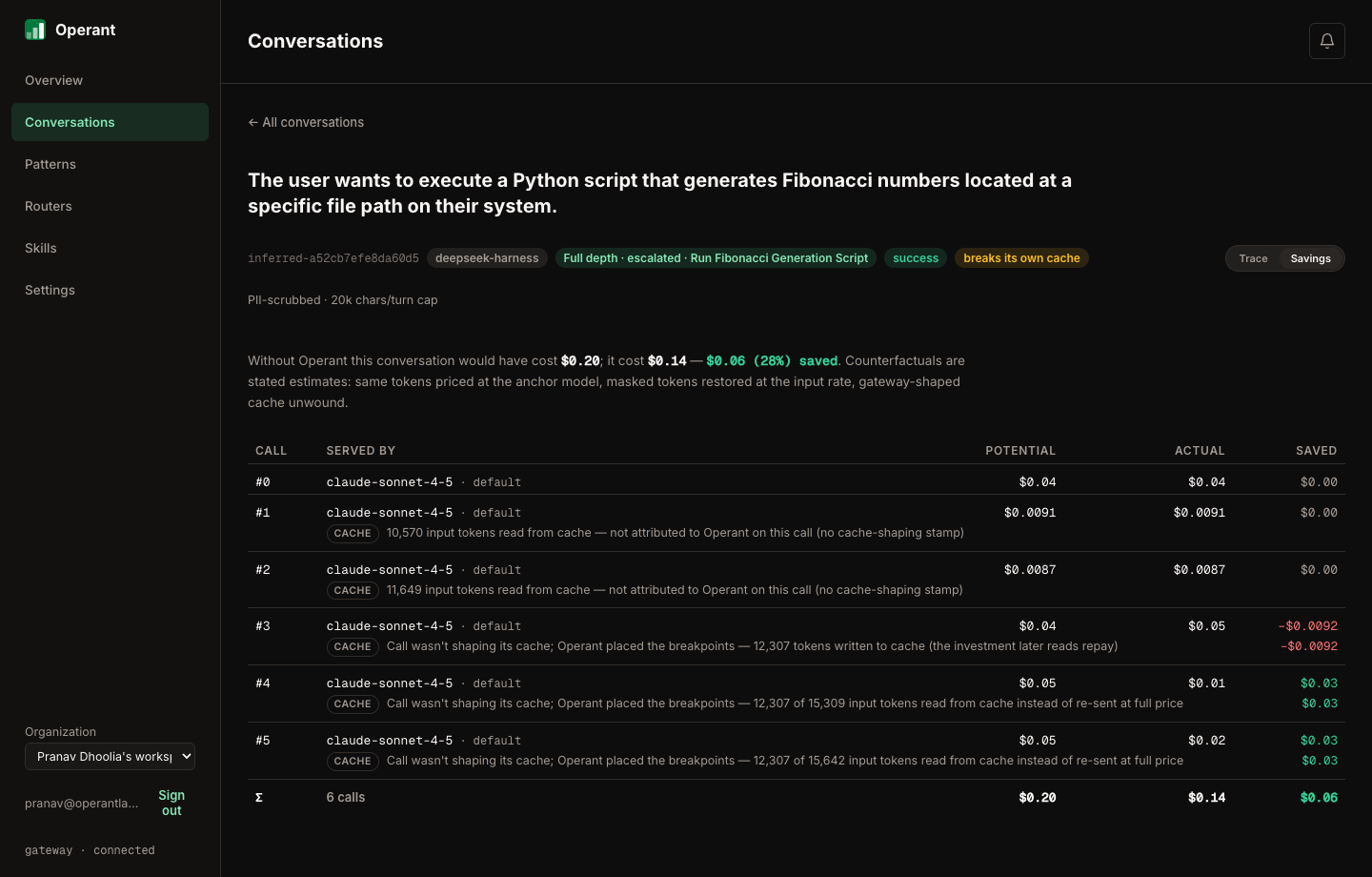
Every call gets three numbers. The first is what the same work would have cost without Operant. The second is what it actually cost, and the third is the difference. A call on a model with no known price shows a dash instead. The assumptions are written out in the open, so anyone can work the numbers out again.
How it's built
Operant is the commercial side of an engine called Strata. The engine does the core work. It handles the traffic, makes the fixes, groups the work and keeps the savings record. Operant adds the brand, this site and the hosted service. Nothing in the path of your data is hidden from the engine's record.
The full loop is shipped and works end to end. It watches, groups the work, learns a skill, tests it, waits for your approval and shows the savings land. We think up to 50% of a production agent's bill is this kind of waste (the four leaks).
We're starting small, with a few design partners and a free two-week waste audit. If the audit says your workload is too small to be worth it, we'll tell you that too.
So your bill can shrink one proven step at a time, and you always have a way back.
See how each saving is proven in the savings record.